The Shape of a Story: Understanding Narrative Structure
Published
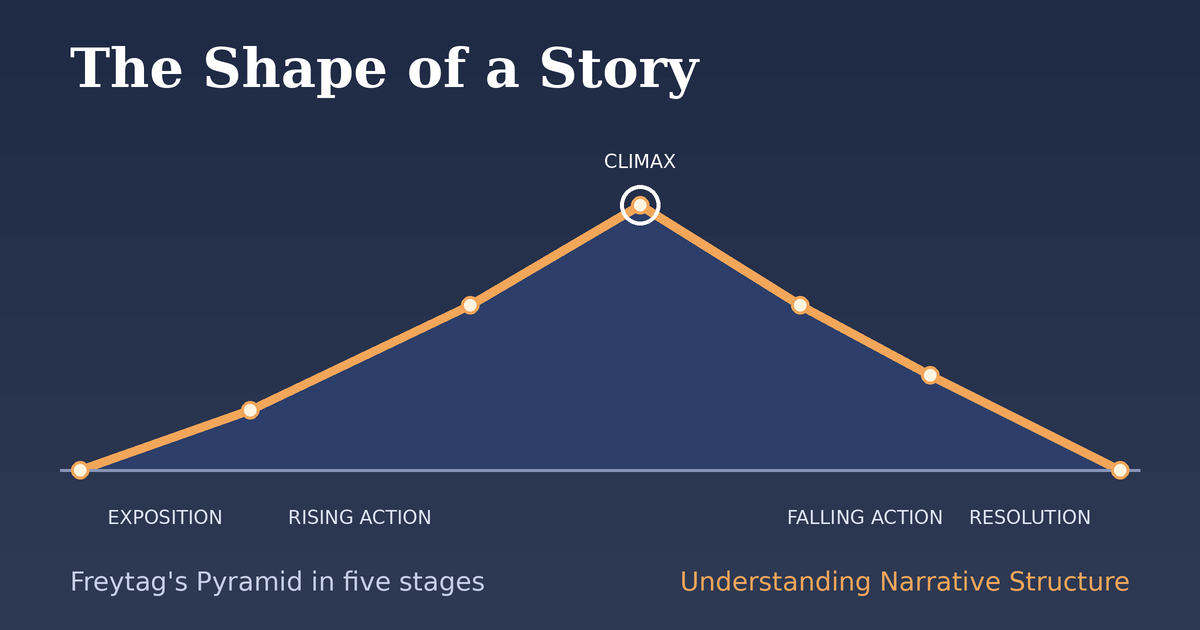
Every story, from a bedtime fable to a prestige drama, moves. Something is established, something goes wrong, tension climbs, something breaks, and the dust settles. For well over a century, writers and teachers have mapped that movement with a model known as Freytag's Pyramid. Whether you are drafting a novel, outlining a script, or trying to work out why a favorite finale landed so well, the five stages of this framework (exposition, rising action, climax, falling action, and resolution) give you a shared language for how stories hold attention.
Where the Framework Comes From
The model is named for Gustav Freytag, a German novelist and playwright who set out his system for dramatic structure in Die Technik des Dramas (The Technique of the Drama) in 1863. An English translation, Freytag's Technique of the Drama, appeared in 1894 [1]. Readers who want the primary source can find the German original on Project Gutenberg [2] and the early English translation on the Internet Archive [3].
Freytag was building on older ideas. According to MasterClass, he drew on Aristotle's Poetics, which saw drama as a three-part, triangle-like shape, and on Horace's Ars Poetica, which stretched dramatic structure to five acts [4]. A Utrecht University dramaturgy database describes his book as a textbook for playwrights that treated the five-act drama as its model and charted the acts as a course of rising and falling tension [5].
Picture the result as a pyramid. Exposition sits low on the left, the action climbs toward a peak, and then descends along the right side toward the base [4]. Each slope and the summit is a stage of the story.
1. Exposition: Setting the Stage
Exposition is the part of the narrative where the scene is set, characters are introduced, and the situation is established. It usually lives at the start of a work, though writers often scatter additional exposition throughout [6].
Take Romeo and Juliet, a play that fits Freytag's five-act model closely. Its exposition tells us we are in Verona, that two families are locked in an old feud, and that a young man named Romeo is lovesick and restless. Nothing has exploded yet, but the conditions for an explosion are on the table. Good exposition does exactly that: it makes the reader understand what is normal, and what is at risk.
2. Rising Action: Complications Mount
In the rising action, events complicate or intensify the conflict, or introduce additional conflicts [6]. This is often the longest stretch of a story, and the instructors at Writers.com point out that it should explore far more than plot alone, including character and theme [7].
In our example, Romeo meets Juliet at a masked party, the pair fall in love, and they marry in secret. Every step deepens the problem, because the more the lovers have to lose, the more dangerous the feud becomes. A healthy rising action behaves like a staircase: each step is higher than the last, and there is no easy way back down.
3. Climax: The Turning Point
The climax is the turning point of the narrative, the moment that transitions the story from rising to falling action [6]. In Freytag's pyramid it occupies the highest point of the structure [4], and in his classical five-act model it sits near the middle of the drama [8].
In most readings of Romeo and Juliet, that moment arrives in the third act, when Mercutio and Tybalt are killed in a street fight and Romeo is banished. The hero's fortunes reverse, and the story can no longer end happily by simple means. Notice that the climax is defined by consequence, not volume. A climax can be a quiet decision or a single sentence, as long as it changes the direction of everything that follows.
4. Falling Action: The Aftermath
Falling action explores the aftermath of the climax. Writers.com describes it as often the trickiest part to write: if the rising action pulls the story away from the ordinary, the falling action settles into a changed version of ordinary [7]. Excellence in Literature adds that this is the stage in which the problems built up during the rising action are worked out [6].
Here Freytag's model differs most from modern habits. Because he placed the climax in the middle, his falling action is long. EditorWorld notes that what many modern writers call the climax, the final confrontation near the end, falls inside Freytag's falling action, and that readers accustomed to a quick wrap-up can find his longer descent slow [8]. In our play, this is the stretch of failed messages, the sleeping potion, and the rush toward the tomb: tension is still high, but the direction of the story is already set.
5. Resolution (Dénouement): Tying It Together
The final stage is the resolution, often called the dénouement. Britannica defines it as the conclusion after the climax in which the plot's complexities are unraveled and the conflict is finally resolved. In a traditional plot, the villain may be exposed, the mystery explained, or the lovers reunited, and in a tragedy the conclusion is often called the catastrophe [9]. The word comes from French and refers to untying a knot, which is a useful image for what this stage does.
Dénouements frequently restore order. Save My Exams points to Shakespeare's habit of closing on a return to stability: the families in Romeo and Juliet make peace after the deaths of the lovers, and in Macbeth the new king Malcolm promises to bring peace back to Scotland [10]. The same source notes that a dénouement can also subvert expectations, as in J.B. Priestley's An Inspector Calls, which ends on a twist instead of a tidy resolution [10].
Where the Model Bends
Freytag's Pyramid is a map, not a law. LitCharts cautions that not every work fits neatly into it, and that many modernist and postmodern writers deliberately subvert this kind of plot structure. It even argues that a "to be continued" ending counts as a form of dénouement, since leaving things open is itself a way of concluding [11].
The model also relates to the three-act structure many screenwriters use. EditorWorld explains that exposition and the start of the rising action correspond to Act One, the rest of the rising action fills Act Two, and the falling action and dénouement fall into Act Three [8]. Seen this way, the two frameworks are not rivals. Freytag simply divides the same territory more finely.
Putting the Structure to Work
For writers, the five stages work best as diagnostic questions rather than a template to fill in:
- Exposition: Does the reader know what normal looks like, and what could be lost?
- Rising action: Does each scene raise the stakes or complicate the conflict, or does the tension plateau?
- Climax: Is there a clear turning point after which nothing can go back to the way it was?
- Falling action: Do the consequences of the climax play out in a way that feels earned?
- Resolution: Does the ending answer the questions the story raised, even if the answer is deliberately open?
For readers, the same questions turn a story you enjoyed into a story you understand. Once you can see the pyramid, you can see why a slow opening paid off, why a rushed ending felt hollow, or why a book that broke every rule still held you to the last page.
Narrative structure will not write a story for you, but it explains why stories we love feel the way they do. Tension builds, breaks, and settles, and a storyteller who understands that rhythm can choose when to follow it and when to defy it.
Sources
- Wikipedia, "Gustav Freytag." https://en.wikipedia.org/wiki/Gustav_Freytag
- Gustav Freytag, Die Technik des Dramas (German original), Project Gutenberg. https://www.gutenberg.org/ebooks/50616
- Gustav Freytag, Freytag's Technique of the Drama (English translation by Elias J. MacEwan), Internet Archive. https://ia600208.us.archive.org/25/items/freytagstechniqu00freyuoft/freytagstechniqu00freyuoft.pdf
- MasterClass, "Freytag's Pyramid." https://www.masterclass.com/articles/freytags-pyramid
- Utrecht University Dramaturgy Database, "Die Technik des Dramas." https://dramaturgydatabase.hum.uu.nl/record/die-technik-des-dramas/
- Excellence in Literature, "Plot Diagram: Freytag's Pyramid." https://www.excellence-in-literature.com/?p=13211
- Writers.com, "The 5 Elements of Dramatic Structure: Understanding Freytag's Pyramid." https://writers.com/freytags-pyramid
- EditorWorld, "Freytag's Pyramid and Five-Act Structure." https://www.editorworld.com/article/freytags-pyramid
- Encyclopaedia Britannica, "Denouement." https://www.britannica.com/art/denouement
- Save My Exams, "Denouement: GCSE English Language Definition." https://www.savemyexams.com/glossary/gcse/english-language/denouement-definition/
- LitCharts, "Dénouement Definition." https://www.litcharts.com/literary-devices-and-terms/denouement
The Romeo and Juliet plot points used as a running example are common critical readings of the play and are offered as the author's illustration rather than drawn from the sources above.