Creating Compelling Dialogue: Writing Conversations That Reveal Character and Drive the Story
Published
Great dialogue does something odd: it sounds like real speech while being nothing like it. Transcribe an actual conversation and you get false starts, filler, and long detours. Put that on the page and readers drift away. Effective fiction dialogue is selective, shaped, and always working. It reveals who people are, builds tension, and pushes the story forward, all while sounding as though it just happened. This guide covers the techniques that make that possible.
Give Every Line a Job
Before polishing a single line, ask what the exchange is for. Writer Robert Gray, in a piece on the requirements of dialogue, names three: it should reveal character, build tension, and advance the plot [1]. His formula is tidy: revealing character plus building tension is what moves the plot, rather than an info-dump doing the heavy lifting [1].
MasterClass lists a similar set of purposes: creating conflict, providing exposition, revealing subtext, and establishing voice [2]. It points out that spoken exchanges make tension visible in a way narration from a distance cannot, and that dialogue can present opposing viewpoints directly [2].
A useful test follows from this: if you can delete a line of dialogue and lose neither character, tension, nor information, delete it. Spines makes the same point from the other direction, advising writers to cut small talk that neither moves the plot nor reveals character. A routine greeting adds little, while a conversation about a risky decision keeps the story going [3].
Let Dialogue Reveal Character
Characters should be recognizable by how they talk. According to Robert Gray, dialogue shows motives, intelligence, social standing, and personality, so readers can reach their own conclusions instead of being told what to think. His example comes from Dickens: rather than announcing that Scrooge is bitter and hates Christmas, Dickens lets Scrooge voice his scorn in a conversation with his nephew [1].
That is the heart of it. Narration can say a character is cold, but a cold remark proves it. MasterClass calls this establishing voice: distinctive speech patterns, rhythms, and perspectives reveal who a character is and what they think, and the speech should suit the specific person [2].
In practice, give each major character a way of talking. One might speak in short, clipped sentences. Another might ramble, hedge, and circle back. A third might never answer a question directly. If you could swap the names above two lines of dialogue and nobody would notice, your characters share a voice, and the dialogue is not yet doing its job.
Make It Sound Real (Without Being Real)
Spines offers several techniques for natural-sounding speech [3]:
- Use contractions and casual phrasing. Spoken language leans on contractions, slang, and informal wording. "I'm not sure if I can make it" sounds more natural than a stiff, formal version of the same thought.
- Include interruptions and broken speech. Real people cut each other off, trail off, and jump between topics, and fragments and hesitation make a character sound human.
- Read your dialogue aloud. Speaking lines out loud exposes clunky phrasing and tells you whether the rhythm sounds like real speech. Spines also suggests recording overheard conversations and studying their flow.
The key word is suggest. You are not copying speech but borrowing its texture. Realistic dialogue is edited dialogue.
Master Subtext
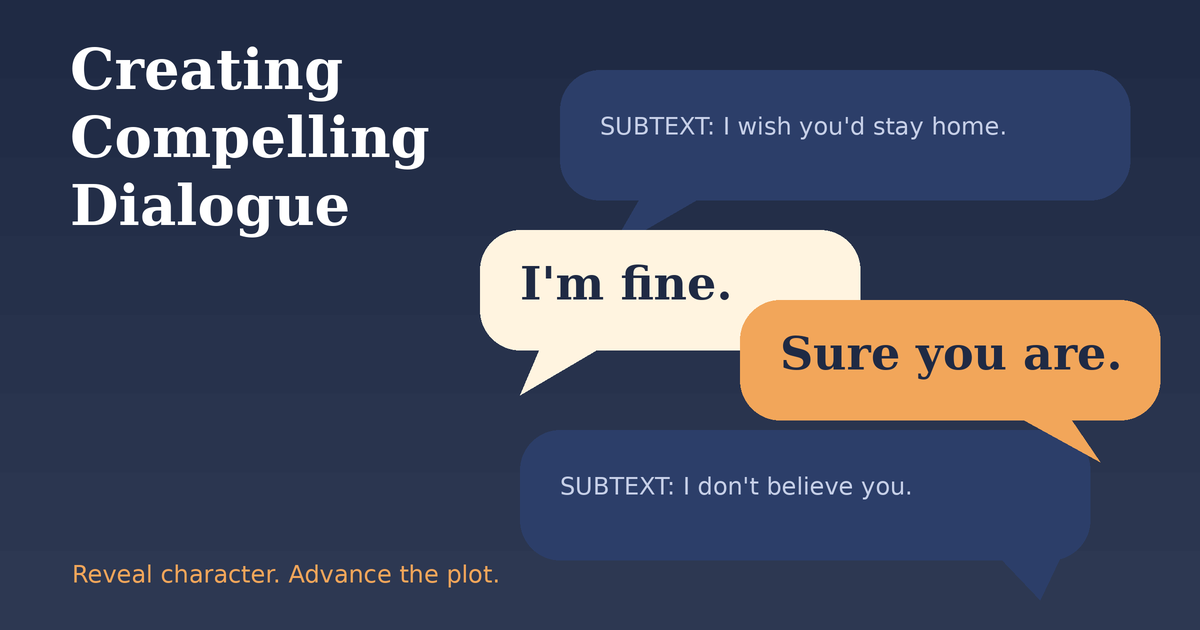
If one technique separates amateur dialogue from professional, it is subtext: the meaning beneath the words. Spines gives a simple illustration. A line as ordinary as "You're always working late" can signal loneliness and feeling neglected, even though on the surface it is a plain remark [3]. MasterClass adds that dialogue can hint at hidden feelings or motives beneath literal words, and that tags and gestures can reinforce this, such as a character praising a dress while a smirk crosses her face [2].
The opposite failure has a name: on-the-nose dialogue. No Film School describes it as characters stating their thoughts, feelings, or intentions outright, leaving nothing to infer, which makes the exchange flat and expository. The site contrasts a character announcing that they are very angry with a subtler line about how the other person always knows how to ruin their day, which lets the audience read the feeling instead [4].
Why does this matter? The same source gives three reasons. People rarely voice their deepest feelings so directly, so blunt characters start to sound like mouthpieces for the writer. When everything is spelled out, audiences have little to interpret and disengage. And unspoken meaning creates the tension and depth that blunt dialogue removes [4].
Its recommended fixes are practical: convey emotion through action and body language, have characters speak around their feelings rather than about them, study real conversations in which people deflect, change the subject, or leave sentences unfinished, and get feedback from other writers. The article also offers a fair caveat: blunt lines are not always wrong, but they work best when the story has earned them [4].
Here is a quick illustration of our own. On the nose: "I'm scared you're going to leave me." With subtext: "Did you pack already, or are you waiting until the last minute again?" The second line never mentions fear, yet the fear is the whole point.
Handle Tags and Action Beats Lightly
Dialogue tags (the "he said" and "she asked" attached to a line) and action beats (small bits of physical business) keep readers oriented. MasterClass's guidance is to use tags sparingly [5]. They are most useful when a new speaker enters, and in a quick back-and-forth they can often be dropped after the first few lines, with indentation and context showing who is speaking. Overusing them distracts the reader [5].
The article acknowledges that writers disagree about "said." Some find repeated uses lazy, while others value how invisible it is. It suggests a middle path: reach for more vivid verbs, but only occasionally [5].
Action beats offer a smart alternative. Describing a character's gestures or body language signals who is speaking and makes the scene feel more active [5]. Better still, a beat can do double duty as subtext. A character who says "I'm fine" while methodically stacking and restacking the same papers has told the reader the opposite.
Finally, you do not always need to quote. The same source notes that indirect dialogue, which summarizes what a character said instead of quoting it, conveys information without needing a tag [5].
Build Tension Into the Exchange
Dialogue works hardest when the speakers want different things. Gray's example comes from Charlotte's Web: a brief exchange in the opening lines about a father heading to the hog house with an ax, just after pigs were born, creates immediate unease without any narrator explaining why [1].
When you draft a scene, try giving each speaker a goal that conflicts with the other's. One character wants information, the other wants to avoid giving it. One wants to confess, the other wants to change the subject. Conversation with opposing goals produces interruptions, evasions, and loaded silences almost on its own.
A Quick Revision Checklist
Once the draft exists, run each dialogue scene through these questions, which draw on the sources above:
- Does each line have a job? It should reveal character, build tension, or advance the plot, ideally more than one [1].
- Can I cut the small talk? Remove greetings and filler that do neither [3].
- Does each speaker sound distinct? Voice should suit the specific character [2].
- Is anything too on the nose? Look for lines where feelings are announced instead of implied [4].
- Have I read it aloud? Awkward rhythm shows up instantly in the ear [3].
- Are my tags light? Trim them in fast exchanges and swap some for action beats [5].
The Takeaway
Compelling dialogue is not about capturing how people really talk. It is about capturing what they mean, what they hide, and what they want, in lines that sound like speech and work like plot. Give every exchange a purpose, let subtext do the heavy lifting, keep tags quiet, and read it all out loud. Do that, and readers will hear your characters long after they close the book.
Sources
- Robert Gray, "Gray Matter: The Three Requirements of Dialogue." https://hellnotes.com/gray-matter-the-three-requirements-of-dialogue/
- MasterClass, "Ways to Use Dialogue in Your Writing." https://www.masterclass.com/articles/ways-to-use-dialogue-in-your-writing
- Spines, "10 Tips for Writing Realistic Dialogue in Fiction." https://spines.com/10-tips-for-writing-realistic-dialogue-in-fiction/
- No Film School, "What Is 'On the Nose' Dialogue?" https://nofilmschool.com/on-the-nose-dialogue
- MasterClass, "How to Use Dialogue Tags." https://www.masterclass.com/articles/how-to-use-dialogue-tags
The sample lines on fear and packing, the paper-stacking example, the conflicting-goals suggestion, and the revision checklist structure are the author's own illustrations and synthesis.