The Art of Character Development: Building People Readers Believe In
Published
Plot can get a reader to turn the page, but character is why they care what happens on it. A story full of clever twists falls flat if the people inside it feel like cardboard, and a quiet story can grip us completely when its characters feel real. So what separates a character who lives on the page from one who merely moves through it? Three ideas do most of the work: dimension, motivation, and change. This guide walks through each one, with examples from stories you probably know.
Start With Dimension: Flat vs. Round
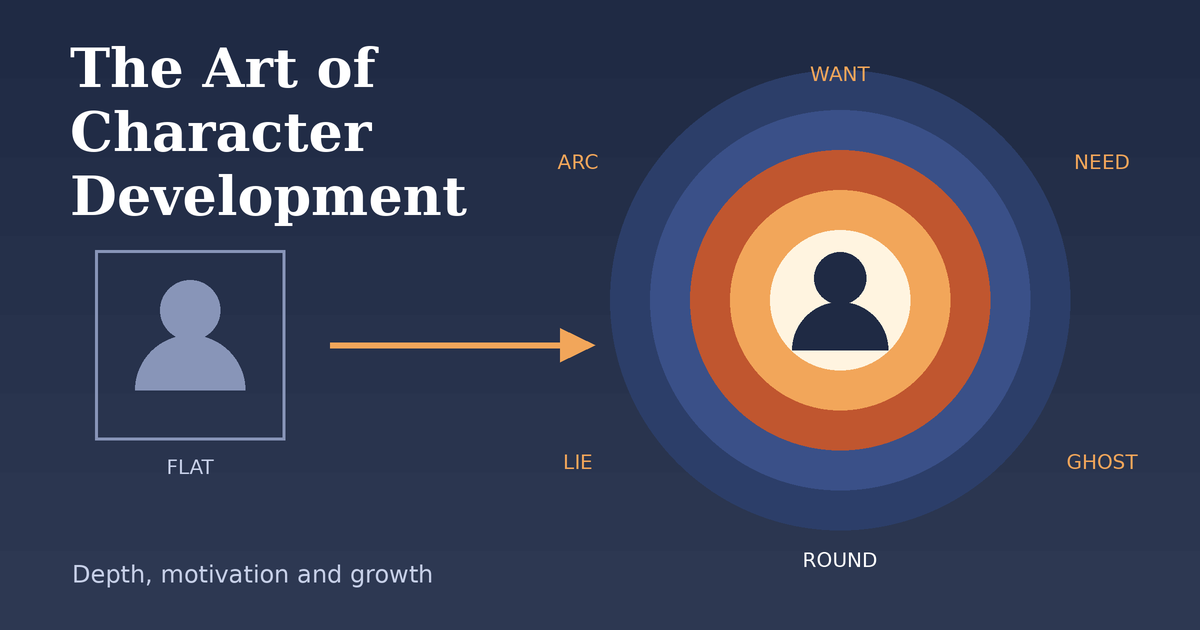
The most famous way to talk about character depth comes from novelist E.M. Forster, whose Aspects of the Novel separates flat characters, whose characterization is simple and straightforward, from round characters, whose characterization is more complex and developed [1]. One summary of the book describes flat characters as built around a single trait, which makes them easy to recognize and remember, while round characters carry many traits that make them seem three-dimensional [2].
Importantly, Forster did not treat flat as a synonym for bad. According to Encyclopedia.com, he found value in both kinds. Dickens, whose characters can mostly be summed up in a sentence, still created a vision of humanity that is not shallow, while Austen's characters are all round, in Forster's view [1]. The same source notes that Proust used flat characters to set off the round ones [1].
That is a useful lesson in itself. Not every character needs a full psychological portrait. A shopkeeper who appears in one scene can be flat, and probably should be. Reserve your depth for the people your story is really about.
How do you know when you have achieved a round character? Forster's closest thing to a test, as one reader summarizes it using his Austen example, is that a round character responds to an unexpected event in a way that is surprising yet still fits what we know of their personality [2]. If a character can only ever do the predictable thing, they are flat. If they can do something that startles us and then, a moment later, feels inevitable, they are round.
Give Them Something to Want, and Something to Need
Depth does not come from a long list of quirks and a favorite color. It comes from motivation, and the most practical framework splits motivation into two layers: what a character wants and what they need.
Final Draft's writing blog describes a want as the concrete goal a character pursues, the one the audience sees and usually identifies early. Wants drive the plot, and each action meets resistance that creates new consequences. A need, by contrast, is the emotional or psychological issue under the surface, such as fear, insecurity, guilt, anger, or selfishness, and characters often don't realize what they need at the start [3].
The article offers memorable pairings. Indiana Jones wants to beat the Nazis to the Ark, but he must also come to terms with his lack of faith. Rocky wants to last the distance with Apollo Creed, but he needs to overcome his self-doubt [3]. The want keeps the story moving, while the need gives it emotional weight, and the strongest stories tie the two together so that chasing the external goal forces the internal change [3].
A handy trick from the same source for finding a hidden need: start with the external goal and ask why the character needs it so badly. In Indiana Jones and the Last Crusade, Indy's strained relationship with his father reveals the wound behind his quest [3].
Dig Into the Past: Ghost, Wound, Lie
Where do needs come from? Usually from the past. A VidLit article on character craft breaks the idea into four connected pieces, using Dickens's Scrooge as its example [4]:
- The ghost is the past event that still shapes the character in the present. For Scrooge, it is a lonely childhood in which his father left him at a harsh boarding school.
- The wound is the deep psychological pain driving the need to change. Scrooge feels unloved, so he chases money instead of relationships.
- The lie is the mistaken belief the character holds at the start, one that once helped them cope but now keeps causing harm. Scrooge believes a person's worth is measured by wealth.
- The weakness is the flaw that shows up in behavior, often involving hurting others. Scrooge's is his cruel contempt for the poor and vulnerable.
Reedsy's guide to character arcs uses a close cousin of this idea, describing three core elements: the goal (what the character wants), the lie (a mistaken belief that keeps them from the goal), and the truth (the more accurate understanding they need) [5]. Notice how neatly the two frameworks align. The ghost explains the wound, the wound produces the lie, the lie shapes the weakness, and the story exists to test all of it.
Reedsy also offers blunt but sound advice: give your character flaws, because readers respond to imperfection, and a flawless character has no room to grow [5].
Plot the Change: Three Kinds of Arc
A character arc is the inner journey a character takes as the story unfolds, in which their beliefs, personality, or outlook shift, and their choices under pressure show that change [5]. Final Draft sorts arcs into three common types [6].
The positive arc. The protagonist grows, learns a lesson, and overcomes a flaw. This does not always mean a happy ending. Final Draft points to Casablanca, where Rick Blaine moves from self-interest to sacrificing his own happiness for a greater cause, and to Schindler's List, where Oskar Schindler shifts from profit-driven to risking his fortune to save lives [6]. Reedsy's example is the one we have already met: Scrooge, who changes from a greedy miser into a generous member of his community [5].
The flat arc. Here the protagonist does not change internally. Final Draft notes that such characters face challenges but keep their core beliefs, and the focus falls on the plot's outcome, as in episodic mysteries and adventures with figures like Sherlock Holmes, Hercule Poirot, and Indiana Jones [6]. Reedsy adds a useful twist: in a flat arc, the protagonist already understands the truth and works to open others' eyes, as Atticus Finch does in shaping his daughter Scout's growth in To Kill a Mockingbird [5]. A flat arc is not a lazy arc. The character stays steady while the world, or the people around them, change.
The negative arc. The protagonist fails and ends up worse off, often through corruption or a personal flaw. Final Draft's signature example is Michael Corleone in The Godfather, who vows to stay out of the family business but gradually becomes its powerful, morally diminished leader [6]. Reedsy describes the pattern as a character who pursues a goal in a self-destructive way and ignores warning signs, citing Jay Gatsby and Walter White [5].
Putting It Together: A Quick Checklist
You do not need to fill out a forty-page character questionnaire. These questions, drawn from the ideas above, cover most of what matters:
- How much dimension does this character deserve? Main characters should be round. Minor ones can be flat.
- What do they want? Make it concrete and visible.
- What do they need? Find the emotional issue beneath the goal, and make the pursuit of the want force them to face it.
- What past event shaped them, and what false belief did it leave behind? Let that lie color their choices.
- What kind of arc is this? Decide whether the character will grow, hold firm, or fall, and make sure the climax tests that choice.
- Can they surprise us convincingly? Give them at least one moment where they act against type in a way that still feels true.
The Payoff
Character development is not decoration. It is the engine under the story. When a character's want collides with their need, when an old wound keeps feeding a false belief, and when the plot finally forces a choice, readers do not just watch events unfold. They feel them. Build people with dimension, give them something to chase and something to heal, and let the story test them. The rest of the plot will follow.
Sources
- Encyclopedia.com, "Aspects of the Novel." https://www.encyclopedia.com/arts/culture-magazines/aspects-novel
- John Pistelli, "E. M. Forster, Aspects of the Novel." https://johnpistelli.com/2020/05/19/e-m-forster-aspects-of-the-novel/
- Final Draft, "The Difference Between What Your Character Wants and What They Need." https://www.finaldraft.com/blog/the-difference-between-what-your-character-wants-and-what-they-need
- VidLit, "What's the Difference? Your Character's Ghost vs. Wound vs. Lie vs. Weakness." https://www.vidlit.com/articles/whats-the-difference-your-characters-ghost-vs-wound-vs-lie-vs-weakness/
- Reedsy, "Character Arc." https://reedsy.com/blog/character-arc/
- Final Draft, "Understanding the 3 Types of Character Arcs." https://www.finaldraft.com/blog/understanding-the-3-types-of-character-arcs
The six-question checklist is the author's own synthesis of the ideas in the sources above.