The Unfinished Yawn
Published
The first time it happened, Nora Hale was alone in the copy room at 3:12 in the morning, proofreading a catalog of garden furniture.
She had worked nights for six years, and she yawned the way other people breathed. This one rose slowly, a great stretching ache that pulled her jaw wide and watered her eyes. At the very top of it, in the soundless pause where the breath turns, she heard a voice. It wasn’t in the room. It was inside her skull, thin and clear, like a radio station between channels.
Did I leave the stove on?
Then nothing. Not silence exactly, but a smoothness, as though something had been lifted off a table without disturbing the cloth.
She thought no more of it until the morning news. A man named Walter Pruitt had vanished from his kitchen in Duluth. His wife found the back door unlocked and the stove burning under an empty kettle. The reporter said it was a strange case, with no signs of struggle.
Nora set down her coffee and noticed that her hands had gone cold.
She told herself it was coincidence for eleven days. Then she yawned on a crowded bus, and a thought slid through her head, bright and bored and young: I wonder if she’ll text me back. The seat across the aisle held a coat, still warm, and a phone lighting up with a message nobody would read. The other passengers looked at the empty seat, then at each other, then away. Nobody screamed. People are very good at not seeing what they cannot afford to see.
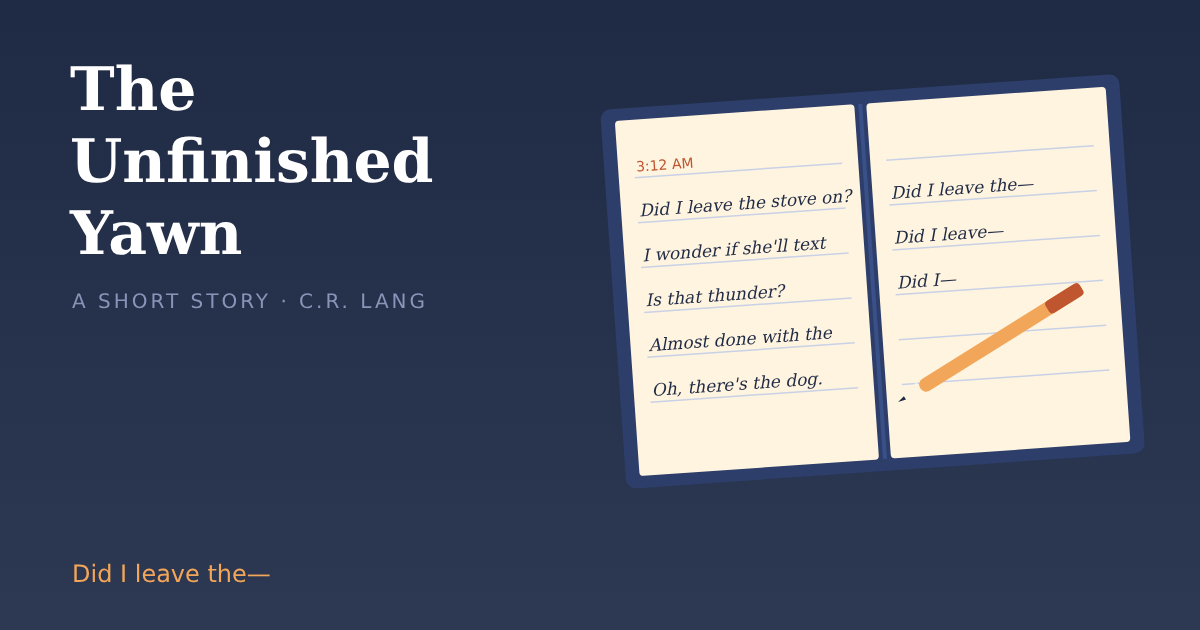
After that she kept a notebook. She wrote down the time, the place, and the thought, because it seemed the least she could do. Someone had to remember them.
I should have called my sister. Is that thunder? Almost done with the crossword. Oh, there’s the dog.
That was the part she could not forgive, the smallness of it. She had expected terror, or prayers, or some last grand sorrow. But no one’s final thought was ever about dying. People disappeared in the middle of ordinary lives, mid-sentence, mid-worry, with a grocery list half composed. The world took them in the act of expecting more.
She tried everything. She drank coffee until her hands shook. She took cold showers, slapped her own face, and pinned her sleeve to her arm with a safety pin so the pain would keep her sharp. But a yawn is not a decision. It arrives from some older part of the body, and her exhausted body, starved of sleep, brought one every few hours, patient as the tide.
So she learned to stop them.
She found that if she clenched her jaw at the first stirring, if she bit down and breathed through her nose and swallowed hard, the yawn would die half-formed in her throat. It cost her a headache and a swollen, aching hinge of bone. It also cost her something else, which she did not understand until the night of the unfinished yawn.
She was at her desk. The yawn came, and she crushed it, teeth grinding, tears running down her face. At the top of the stalled breath she heard a voice, but it wasn’t finished.
Did I leave the—
It was Walter Pruitt. She knew him now, the way you know a song you have heard too many times. But he should have been gone for months. He should have ended on the word on.
Did I leave the stove—
Did I leave—
Did I—
He was still there. He was caught in the last moment before the vanishing, and her clenched jaw had trapped him in it. He was thinking the same unfinished thought over and over, in the dark, with nowhere to put it. When she finally let her jaw go slack and the yawn escaped, the voice stopped mid-syllable, and the smoothness closed over it like water over a dropped stone.
Nora sat in the humming office light and understood what she had been doing.
She had not been saving anyone. She had been keeping them.
After that she stopped trying to prevent the yawns, but she could not stop hearing the unfinished ones, because the ones she had held back did not go quietly. They gathered. Some nights, in the thin hours between two and four, she could feel them pressed against the inside of her teeth like a held breath, a crowd of small interrupted thoughts waiting for the door to open.
Is that thunder—
I wonder if she’ll—
Almost done with the—
She stopped answering her phone. She stopped going out, because strangers yawn, and yawning is catching, and she had learned that the world’s yawns were not hers alone. Sometimes she heard a voice through the wall, from an apartment where no one should have been home. Once she heard one from the street, and when she looked out the window, the crosswalk was empty and a single shoe lay in the middle of it.
It was not only her. She understood that now. Everyone yawned and everyone was taken, one at a time, by an appetite that had no name. She was only the one who could hear it. She was a witness, and the witness was going slowly, quietly mad.
On the ninetieth night, or the hundredth, she sat on the edge of her bed in the dark with her jaw locked so hard that her molars ached. She had not slept in four days. The walls had started to breathe at the edges, in and out, slow and patient.
The yawn rose. She fought it. It rose again, stronger, a tide against a sandbag. Her eyes streamed. Behind her teeth, the crowd pressed forward, hundreds of voices, all of them unfinished, all of them waiting.
And then one of them spoke that was not like the others.
It did not trail off. It did not ask about stoves or dogs or thunder. It was calm and whole and clear, and it was directed at her.
You can stop holding it now, Nora.
She went rigid.
We’re all so tired. We’ve been waiting so long to finish.
Her jaw began to ache. Then it began to ease, slowly, against her will, a stiff hinge loosening. She felt the pressure behind her teeth shift from a crowd pushing in to a crowd preparing to go out. Her mouth opened wider than she had ever opened it, wider than a mouth should open, and the dark behind her tongue was not the dark of a throat.
Don’t be frightened, the voice said, kindly, as if from very close by. It only takes a moment. And you’ll finally know what we were all thinking.
In the last instant, at the very top of the breath, Nora Hale found that she had one more thought left, and she understood, too late, why they had always been so small.
I should have let myself sleep.
The room was empty. The bed was still warm. And on the nightstand, in a notebook full of last words, a pen rolled slowly to a stop.