Just Out of Sight
Published
John Ferrow had spent eleven years writing books almost no one read, so when the invitation came, he read the email four times before he trusted it. A popular late-night program wanted him as a guest to discuss his latest novel. The taping was at the Alder Theatre, a century-old house the network had restored for the show.
Backstage, the air smelled of hot dust and hairspray. Crew members slid past him with headsets and clipboards, speaking in clipped murmurs. Through the wall, he could hear the host introducing the guest before him, and the laughter that followed. His turn was minutes away. He pressed his damp palms against his knees and tried to recall the first line of the answer he had rehearsed.
He needed air. He told himself he would only walk to the end of the corridor and back.
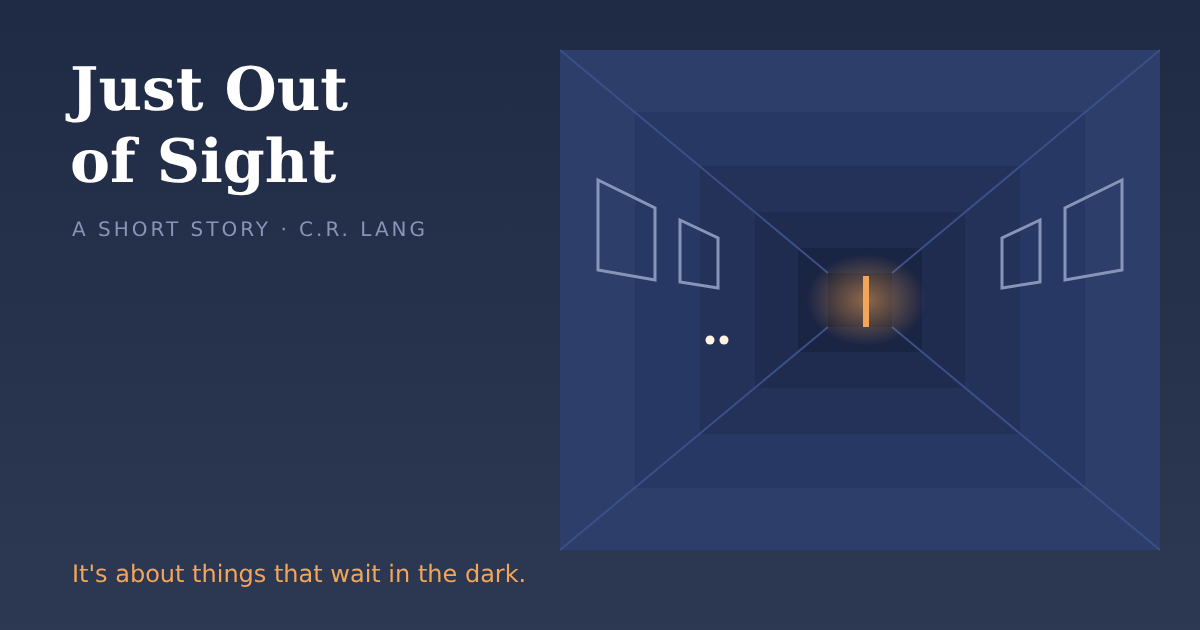
The corridor did not end where he expected. The warm light and the voices thinned behind him, and the floor began to slope, almost imperceptibly, downward. Framed photographs lined the walls, decades of performers in faded sepia, and he noticed, without quite understanding why it bothered him, that none of them were looking at the camera. They were all looking at something just past the photographer’s shoulder. The paint gave way to bare plaster, then to brick. When he finally stopped and turned, the way he had come was a long, dim tunnel with no crew in it and no sound at all. The silence had a quality he could not name, like the silence of a room in which someone has just stopped breathing.
He started back, walking quickly. The corridor seemed longer than it had been. Then, somewhere behind him, came a low sound, wet and unhurried, like something large dragging itself across stone.
John did not look back. He ran.
“John?”
He stopped. It was a woman’s voice, warm and professional, the voice of a producer. It came from the dark ahead of him, where the corridor bent out of sight.
“John, there you are. We’re ready for you. Come this way.”
He took one step toward it. Then he heard the pause between her words, the faint, wet click of a throat rehearsing a sound it had only heard secondhand, and the voice came again, exactly the same, the same warmth, the same rise on his name.
“John? There you are. We’re ready for you.”
He turned and fled the other way.
The hall narrowed until he found a door standing a hand’s width open. Cold air breathed through the gap, carrying the smell of wet earth and something sweeter underneath, like fruit left too long in a warm room. He shouldered the door wide and stepped into the dark beneath the stage.
It was enormous. Beams as thick as tree trunks held up a ceiling lost in shadow, and somewhere far above, muffled by timber, the audience laughed and applauded. The sound was horribly distant, like voices heard from the bottom of a well. Water dripped steadily in the black. The floor was littered with the debris of a century: rotted rigging, shattered flats, the skeleton of a trapdoor lift. Against one pillar, someone had scratched tally marks into the wood, hundreds of them, in rows that ran from knee height to well above his head.
Behind him, the door he had pulled shut creaked open again.
He moved between the pillars, keeping low, and the thing followed. He never saw it. He saw only its effects: a patch of darkness that seemed to deepen where no light fell, a rack of old costumes swaying slowly in air that had not moved, the faint click of something hard against the floorboards, always just outside the reach of his vision. Once, a hand-sized shape slid along the edge of his sight and was gone, too many-jointed to be anything he wanted to name.
He crouched behind a splintered crate and clamped a hand over his mouth. The clicking stopped on the other side of the wood. He heard it breathe in, long and patient, as though tasting the air for him. A thread of warm, sweet breath curled around the edge of the crate. His own breath was trapped in his chest like a stone.
Then, close enough to stir his hair, a whisper that was his own voice said, “It’s about things that wait in the dark.”
His stomach turned to ice. It was the answer he had rehearsed that evening, alone, in the mirror of his dressing room. He had said it to no one.
Then it exhaled, and he understood that it was smiling.
He bolted. His lungs burned and his shins cracked against unseen wreckage, and behind him the clicking became a gallop, then something worse, a slow, delighted scrabbling, like a thing that had waited so long it no longer needed to hurry. But ahead, through a gap in the forest of beams, he saw a thin seam of gold light. He threw himself toward it, clawed up a short flight of stairs, and burst through a service door into the wings, into noise and heat and the smell of hairspray.
A stagehand caught his arm. “Mr. Ferrow? We’ve been looking everywhere. You’re on.”
The host was already smiling, hand outstretched, the audience clapping in a warm roar. John stumbled into the lights and sank into the chair. His hands were shaking. Dust coated his sleeves, and when he glanced down, he saw four long, parallel scratches across the back of his jacket, the fabric peeled open as neatly as a letter. Beneath them, along his spine, he felt the faint, cooling sting of something that had touched skin.
“Welcome, John,” the host said. “Tell us about the book.”
He opened his mouth. Beyond the glare of the stage lights, past the first row, the audience sat in a deep, faceless dark. And at the edge of the wings, just where the light gave out, something stood very still, patient and attentive, waiting for him to finish.
He understood then that it had never needed to catch him. It had only needed him to come back up.
“It’s,” he began, and his voice cracked. “It’s about things that wait in the dark.”
In the wings, in the dark, in a voice that was very nearly his own, something whispered the words along with him.